A price can rise twelve times as fast and still push CPI less
US lodging prices rose 2.4% in August from the previous month; owners' equivalent rent rose 0.2%. Yet owners' equivalent rent contributed 1.5 times as much to all-items CPI. Before using the release as a reason to buy bonds or growth stocks, look at the weight a component left in the index.
The BLS monthly effects table assigns 0.048 percentage points to owners' equivalent rent and 0.032 to lodging away from home, including hotels. Lodging's price change was 2.4÷0.2=12 times as large, but its contribution was smaller: 0.032÷0.048. How much an item's price changed and how much it moved the whole index are different questions.
Its weight in the index creates the difference. Owners' equivalent rent (OER) estimates the rental value of housing services provided by owner-occupied homes; it is not house prices. A component with a large expenditure weight can move overall inflation more even with a smaller price increase. The chart's left panel shows component price changes; the right shows all-items CPI contributions. The rankings reverse.
| August component | Monthly change, seasonally adjusted | Contribution to all-items CPI |
|---|---|---|
| Owners' equivalent rent | +0.2% | +0.048 percentage points |
| Lodging away from home | +2.4% | +0.032 percentage points |
Contributions are the seasonally adjusted monthly effects in BLS Table 6. Lodging includes accommodations other than hotels.
Core inflation contributed more than the energy rebound
Gasoline rose 3.9% in August; BLS said it accounted for more than one-third of the monthly all-items increase. Energy also reversed from −1.5% in the preceding month to +2.1%. It was a visible cause, but it was not the whole composition.
Energy contributed 0.150 percentage points to the monthly all-items CPI rise. Core components excluding food and energy contributed more, at 0.230 percentage points. Shelter is included in core. This composition weakens the shortcut that the whole increase can be ignored once gasoline settles.
That shortcut is what Whalehunter questions in this release. Even after separating the energy rebound, core pressure needs its own examination. For someone betting on bond prices rising, the useful check is whether inflation is easing broadly enough to support lower yields.
| Component | All-items CPI contribution | Relationship |
|---|---|---|
| Core, excluding food and energy | +0.230 percentage points | Includes shelter |
| Energy | +0.150 percentage points | Includes gasoline |
| Shelter | +0.093 percentage points | A subset of core |
Seasonally adjusted monthly effects from BLS Table 6. Shelter is already included in core, so do not add all three rows.
The 2.4% annual core headline does not replace the monthly pace
There is favorable evidence too. Year-over-year core CPI declined from 2.5% in July to 2.4% in August. But its monthly change increased from 0.2% to 0.3%. All-items annual inflation stayed at 3.4%, while its monthly change rose from 0.1% to 0.4%.
Buying the annual improvement and reading this month's pressure involve different time comparisons. Annual changes compare with the same month a year earlier and are not seasonally adjusted; monthly changes compare with the preceding month and are seasonally adjusted. Calling the lower annual rate the disappearance of monthly pressure erases the tension within the release.
| Measure | July | August |
|---|---|---|
| All-items annual change · Not seasonally adjusted | 3.4% | 3.4% |
| Core annual change · Not seasonally adjusted | 2.5% | 2.4% |
| All-items monthly change · Seasonally adjusted | 0.1% | 0.4% |
| Core monthly change · Seasonally adjusted | 0.2% | 0.3% |
Annual changes compare with the same month a year earlier; monthly changes compare with the prior month. A positive rate means a higher price level than in that comparison period.
OER slowed. Declaring sustained reacceleration is premature too
Reading this argument as a claim that all housing costs heated up again would also be wrong. OER's monthly change eased from 0.3% in July to 0.2% in August, with rent moving in the same direction. Looking only at shelter's overall 0.1%→0.3% change misses that counterevidence.
Lodging's 2.4% increase followed a 2.8% decline. Monthly core changes were also uneven: 0.4% in April, 0.0% in June and 0.3% in August. The judgment here is narrow: retain the core burden after separating energy, while waiting for more than one rebound before buying a sustained reacceleration story.
If the next release shows a slower monthly core pace and continued easing in rent and OER, the disinflation case strengthens. If lodging alone reverses and lowers the overall number while large-weight components remain firm, the improvement is thinner. Which components contribute, and by how much, changes the judgment.
Put your bond's maturity yield alongside your company's sales
Start with bonds. If inflation keeps easing and the market yield for the maturity I hold also falls, other things equal, that supports a fixed-rate bond's price. Selling before maturity or marking a bond fund brings that price into profit and loss. The fixed coupon promised through maturity does not increase because CPI changed.
For growth stocks, separate costs and demand. Lower rates can raise the present value of distant earnings, but a fall in sales and earnings can absorb that benefit. In the next results of a company I own, put sales volume, the revenue outlook and the cost ratio together. The question for my money is whether sales hold up while costs ease.
CPI's OER measures the price of consumers' housing services. It cannot simply be copied into the company's cost statement. Two useful notes are my bond's remaining maturity and its market yield, and my stock's sales volume, revenue outlook and cost ratio. The inflation headline cannot substitute for those observations.
On October 14, check where inflation's weight became lighter
The next CPI release covers September and is scheduled for October 14, 2026, at 08:30 US Eastern Time, or 21:30 KST. Begin with the monthly core change. Compare it with August's 0.3%, then separate rent, OER and lodging.
If the overall increase slowed, check whether energy fell and whether core contributions also became smaller. A large lodging movement alone should not close the argument. Continued easing in large-weight components and the monthly core pace would update this article's judgment.
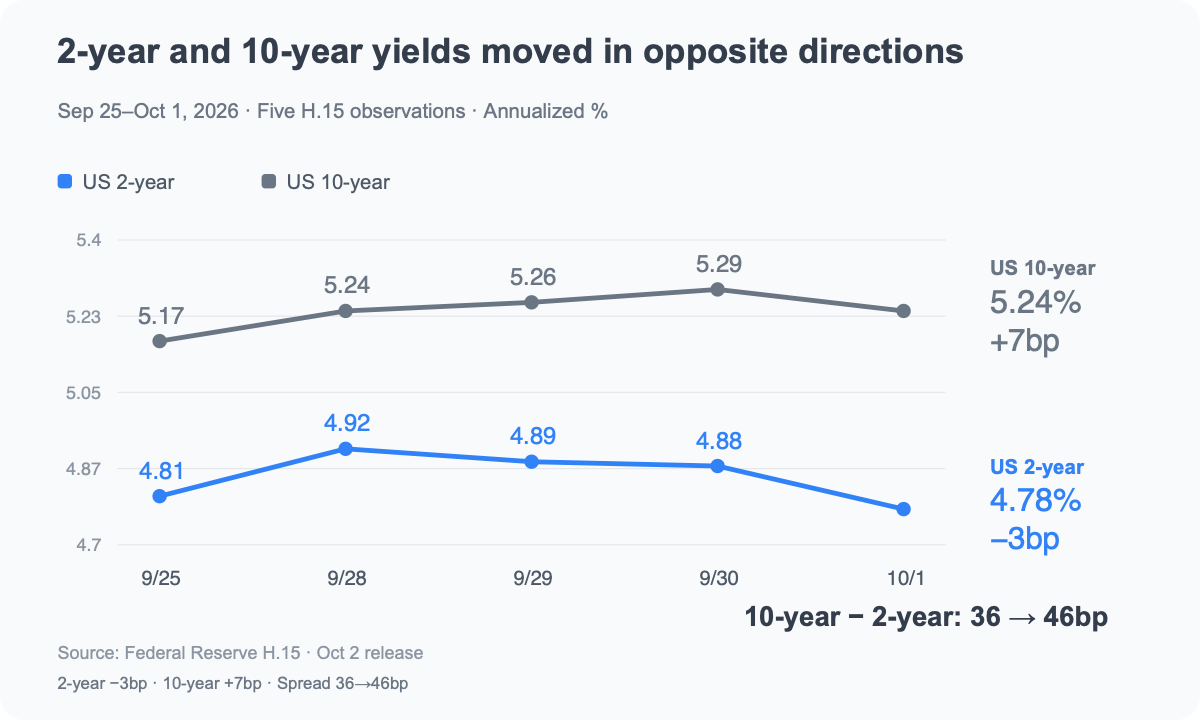
Then check whether the yield for my bond's maturity actually fell. Continue with the next article for why the Fed's policy rate and the 10-year market yield can diverge, and why the same yield change moves a longer bond's price more.
Next checks
- Compare the monthly core change with August's 0.3%
- Separate rent, OER and lodging price changes from their CPI contributions
- Check whether energy and core contributions both eased